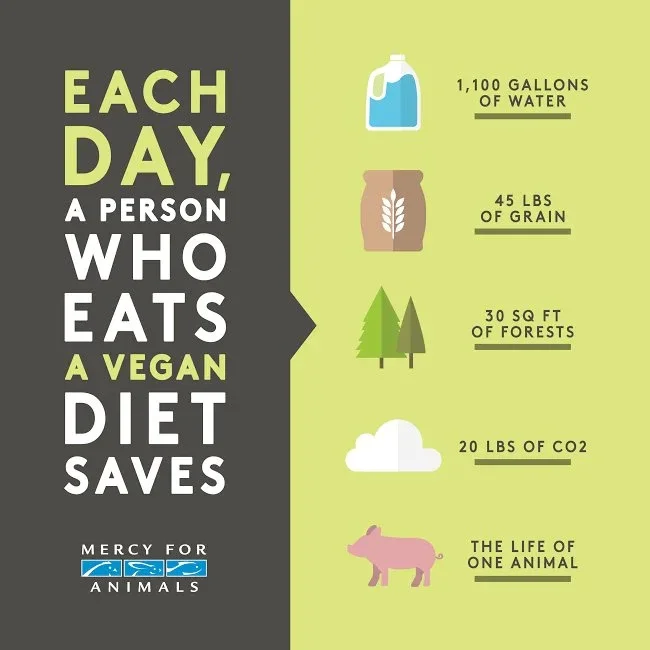
Choosing Vegetarianism Reduces Your Carbon Footprint!
On the environmental side, going vegetarian also reduces your carbon footprint! Vegetarianism offers significant environmental benefits, with studies showing 35%–50% lower greenhouse gas emissions than omnivorous diets. Adopting a vegetarian diet reduces demand for land, lowers water usage, and slows habitat destruction, as meat production uses 50% of fresh water and is a leading cause of land use. We have one planet Earth, the time to save it is NOW!

30,000 Plant Species On Planet Earth!
With 30,000 edible plant species on planet Earth, why are we still killing animals for food? While at least 30,000 plant species are edibleBBC +1), human food consumption is heavily concentrated, with only about 150–200 species used globally and just 12 crops providing 75% of the world's plant-based foodBBC +2). Roughly 3 to 7,000 plant species have been cultivated in human history, though documentation identifies 7,039 edible plant species.
A Plant-Based Diet Reduces Your Carbon Footprint By Up To 2.1 tons! (United Nations, 1).
Our food systems generate one third of our planets greenhouse gas emissions. Animal-based diets have a high impact on our planet. Population growth and an increasing demand for meat and dairy results in the need to clear land and deforestation in order to make room for animal farms and growing animal feed. This results in loss of biodiversity, greater strain on resources like water and energy, among other adverse impacts. In the case of ruminant livestock such as cows and sheep, methane production, a greenhouse gas that is more potent than carbon dioxide, exacerbates the problem. The issue extends to seafood where overfishing and degradation of our oceans from industrial activity and pollution put the future of our ocean at jeopardy. (U.N. 1)
https://www.un.org/en/actnow/food (accessed 04/30/2026)

Going Vegetarian Reduces Greenhouse Gas Emissions By 49%!
Going vegetarian will drastically help to preserve our planet's natural ecosystems! "Transitioning to plant-based diets (PBDs) has the potential to reduce diet-related land use by 76%, diet-related greenhouse gas emissions by 49%, eutrophication by 49%, and green and blue water use by 21% and 14%, respectively, whilst garnering substantial health co-benefits.In total, 70% of all global freshwater withdrawals are used for the irrigation of crops, of which 24% are fed to livestock [5,20]. Approximately 43,000 L of water are required to produce 1 kg of beef, whereas it only takes 1000 L to produce 1 kg of grain." (NIH, pp. 1)
https://pmc.ncbi.nlm.nih.gov/articles/PMC9024616/ (accessed 04/20/2026)
Create Your Own Website With Webador